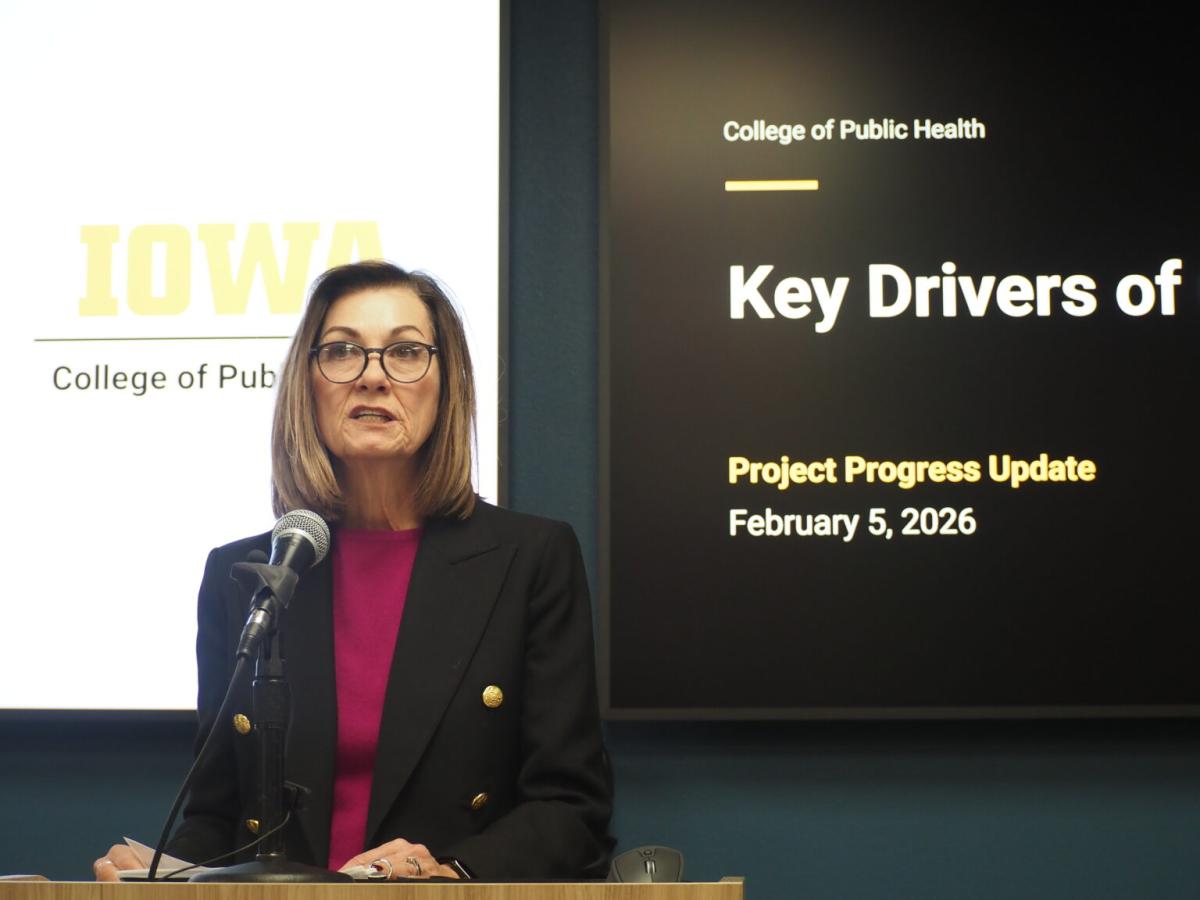
Gov. Kim Reynolds announced Thursday she was introducing legislation that would increase taxes on cigarettes and tobacco products, institute a new tax on consumable hemp and vape products, in addition to other measures that she said will encourage healthier behaviors in Iowa.
The governor spoke about the bill as preliminary findings were shared from the ongoing research project into what factors are driving Iowa’s high incident rates of new cancer. The Iowa Legislature approved Reynolds’ request in 2025 to provide $1 million in funding for the yearlong research project, conducted through a partnership between the Iowa Department of Health and Human Services and the University of Iowa College of Public Health.
While the study is ongoing, initial results show “there isn’t one single cause driving Iowa’s cancer rate,” Reynolds said.
“Still, I understand why so many Iowans want to find that one cause of cancer,” Reynolds said. “When someone you love gets sick, it’s natural to want to put all of your energy and resources into one thing that might stop it from happening again, and I wish the answer was that simple as well. But know … the research will continue to look at all the evidence, including environmental factors, and will act accordingly, based on what the research finds.”
This research project was requested as Iowa faces higher rates of new cancers in comparison to the rest of the nation. The Iowa Cancer Registry found in its annual report Iowa had the second highest age-adjusted rate of new cancers diagnosed in 2025, and is one of only two states in the country with a rising rate of new cancers, and in 2024, had the fastest rising rate.
UI researchers spoke about what their initial research and data analysis shows about the factors contributing to Iowa’s cancer rates, which began rising to be higher by a statistically significant margin in comparison to national rates starting in 2013 and 2014. The interim report found that in 2022, there was an estimated 2,582 more Iowans who were diagnosed with cancer in 2022 in comparison to the national rate when comparing people of the same age and gender.
Though the study is ongoing, researchers cautioned against stating any there is one, specific reason why Iowa’s cancer rates have grown quickly.
Dr. Mary Charlton, UI professor of epidemiology and the Iowa Cancer Registry director, said “the really frustrating thing about cancer is how complex it is,” as it can develop from a variety of genetic, environmental, behavioral factors and combinations therein.
The study identified five types of cancer that “pulls Iowa away from the U.S. trends” of cancer instances — prostate, breast, lung cancer and melanoma, in addition to examining colorectal cancer. There are other types of cancer “that may be slightly pulling our rates away to a lesser degree,” Charlton said, but the focus was on these types of cancer highlighted by researchers as Iowa faces higher rates of these cancer instances compared to the national trend.
The information released Thursday looked specifically at demographic and behavioral factors related to cancer incidences, and compared Iowa to other states with similar rates of risk factors, looking at issues like binge drinking, obesity, income levels, college education and insurance rates. The report showed Iowa was in a “cluster” of states with similar behavioral risk and demographic factors that included North Dakota, South Dakota, Nebraska, Minnesota, and Wisconsin.
In comparison to these other Midwest states, Iowa has similar cancer trends for many of the most common cancer types in Iowa, like melanoma, prostate, breast and colorectal cancers. However, Iowa’s had a significantly higher number of lung cancer instances in comparison to the other states in this cluster.
Iowa’s lung cancer instance rates, as well as mortality rates, are both higher than neighboring states and the national rate.
The role environmental and genetic factors play in Iowa’s high cancer rates were not discussed in the findings shared in the interim report, but will be examined and shared in future updates, researchers said.
Environmental factors have been highlighted as a top concern among many advocates and Democrats, who link Iowa’s growing cancer rates to the presence of high radon in Iowa buildings, high nitrate levels in Iowa waterways and the impacts of agricultural runoff and certain pesticide uses. Leaders in Reynolds’ administration spoke on the need to address exposure to radon, but also said they plan to encourage behavioral practices, like healthy eating and reduced tobacco and alcohol consumption, that can contribute to lower cancer rates.
Dr. Robert Kruse, state medical director, pointed to specific issues tied with higher instances of lung cancer, like smoking and radon exposure, that Iowans can take steps to address on an individual level.
“Cancer outcomes are not predetermined,” Kruse said. “Iowa can reduce preventable risk to detect our cancer earlier and strengthen access to high quality care statewide and across those rural communities, not only in our largest metro areas. And for Iowans watching today, there are steps that matter right now: test your home for radon at least every two years and retest after major renovations. Avoid tobacco, and if you currently use it, make a plan to quit and connect with support that works for you. Limit alcohol — even small amounts of alcohol increase cancer risk.”
He also called for Iowans to ensure they stay physically active and maintain a healthy weight, to protect their skin by wearing sunscreen, long sleeves and avoiding tanning beds, as well as by discussing cancer prevention and screening tests with their health care providers based on age, history and individual risk factors.
Rural health care resources
Kruse also said the state is taking steps through the “Healthy Hometowns” rural health care development plan — funded through the federal Rural Health Transformation Program in Republicans’ 2025 spending bill — to provide additional resources across the state for cancer prevention and early detection.
He said through the federally funded program, Iowa will expand colorectal cancer screening in rural areas, expand radon testing and mitigation, and increase early skin cancer detection training options for rural health care providers. He also said the program will provide more cancer treatment options for rural Iowans through the “hub and spoke” regional model, seeking to expand specialized care options outside of metropolitan areas.
Iowa was awarded $209 million for the first round of funding, which is set to allocate a total of $50 billion to states between 2026 and 2030. The program was created meant to help offset an expected $137 billion decline in rural Medicaid spending over the next 10 years under Republicans’ spending plan.
Restrictions on SNAP benefits, food dyes
In addition to investments through federal funding, the governor said she is introducing a bill — not yet available online — that will require continued restrictions on foods like candy and soft drinks available for purchase through the Supplemental Nutrition Assistance Program, known as SNAP. The proposal also would eliminate certain dyes and additives from being in school lunch programs and require physicians to complete a course on nutrition as part of continuing medical education programs.
The measure also would raise taxes on cigarettes and tobacco products while creating a new tax on consumable hemp and vape products. The tax rates and increases on these products were not specified during the news conference, but Reynolds said the various components of this proposal are all aimed at addressing factors correlated with cancer development.
“Today’s research findings make it very clear how important healthy behaviors are for (Iowans’) overall health and well-being, and my bill aims to really amplify that message,” Reynolds said.
By July 1, 2026, the researchers said they plan to have modeling and mapping analysis completed for lung, melanoma, colorectal and HPV associated cancers. In the second year of the project, the researchers plan to analyze environmental and genetic data, and prepare a report including both findings and recommendations for evidence-based cancer prevention programs for the governor and lawmakers to consider.

Comments
Submit a CommentPlease refresh the page to leave Comment.
Still seeing this message? Press Ctrl + F5 to do a "Hard Refresh".