-
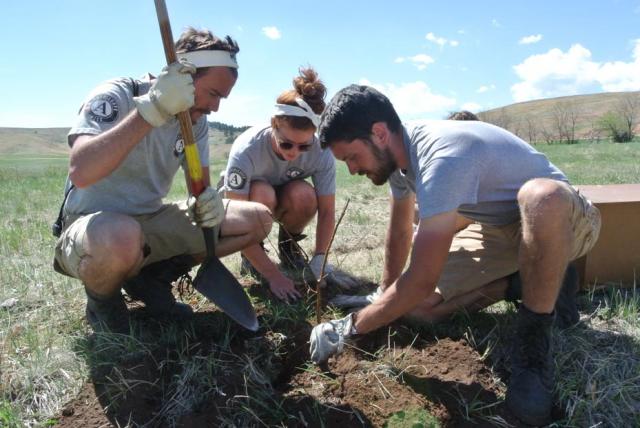 Members Emma Martz, Shad Brooks and Darrel Flanders plant a tree in the plains of Custer State Park.
By: Nicholas Meyers
Cedar 5 was met with rolling hills, green trees and a sky of blue as they arrived in Custer, South Dakota. on May 3. As they travelled it wasn’t hard to spot the brown patches in the sea of green forests caused by the plight of a native species gone rampant, the mountain pine beetle. The NCCC team had arrived to help Custer State Park rangers to eradicate the beetle infestation. Cedar 5 spent much of their time clearing up brush left as the aftermath of an extensive, park-wide offense on the beetle.
State park rangers have come up with several methods to kill the beetles. One is baiting and girdling trees, which attracts beetles to a tree and then kills them. Another method is cutting and chunking, which is cutting up infested trees and exposing beetles to sunlight to kill them. Cedar 5 spent the majority of their time visiting burn piles in which the infested trees were gathered and destroyed. At these sites, the team would plant a seed mix of natural grasses in order to restore the environment to its natural state. The team also planted over 240 trees along a prairie ravine. While there is still much work to be done, Cedar 5 was happy to help preserve the beautiful environment of the Black Hills.
In the past 103 years, state park rangers in the United States as well as natural resource organizations in Canada have been battling the biggest outbreak of mountain pine beetles in recorded history, which is ten times bigger than anything North America has seen before. Due to recent changes in state and national forest management, many natural forest fires have been suppressed by human intervention. Only in the past few decades have park rangers realized that forest fires are a natural part of a forest’s life cycle. Now, due to increased forest density and warmer winters as a result of global climate change, the forests have become the perfect environment for the mountain pine beetle to thrive.

Comments
Submit a CommentPlease refresh the page to leave Comment.
Still seeing this message? Press Ctrl + F5 to do a "Hard Refresh".