
.jpg)






.jpg)

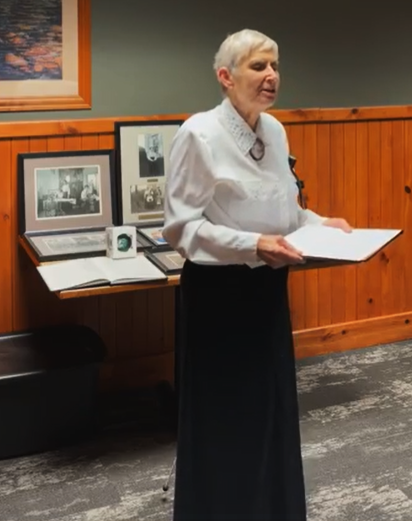
The Vinton Kiwanis had a unique presentation courtesy of member Carolyn Hibbs. She addressed the club as "Lorraina Matese" a teacher and matron at the Iowa College for the Blind, in the year of 1881. This is the year that Mary Ingalls, of "Little House on the Prairie" fame, arrived at the school. Matese was at the school during and after Ingalls attended and is rests in Vinton at the Evergreen Cemetery.
When Ingalls attended, there were two superintendents. Mr. Crothers, and Mr. Thomas McCune.
Born January 10, 1865, the oldest of three children, Ingalls became blind at the age of 14 after the family came down with a case of scarlet fever. Fortunately for the family, Mary was the only who had long lasting affects from the illness. Following the illness, the family moved to Silver Lake, South Dakota. While they lived there, Charles, her father, worked at the railroad camp and the family lived in a shanty.
They stayed through the winter and were the only people on the property. During one of those winter evenings, Reverend Alden, (unlike in the TV series) traveled around as a missionary and had stopped in the cold at the shanty as he was on his way to bring supplies to an Indian reservation.
Alden and Charles knew each other from the family's time at Silver Lake, so both men were surprised to come face to face. Alden and his traveling companion spent the night with the Ingalls. Because of Rev. Alden's travels, he knew about and shared with the family about the school in Vinton, Iowa knowing that it could help Mary. Alden also had a relative that worked at the school.
Caroline Ingalls had always wanted her daughter to get an education, but had feared that because of her blindness this would never happen. The Ingalls family was never well off, so they worked earnestly to save enough to fund tuition for Mary to attend the school. They were still short enough so her education had to be put off until she turned 16. The family finally had enough money to buy train tickets to get her there, as well as room and board. Ma, Pa and Mary all boarded the train from De Smet, South Dakota and arrived in Vinton, Iowa.
Staff from the school, met them at the station and delivered them to the back door of the school where the Superintendent's offices were located. Mr. Crothers and Ms. Matese were in the meeting. The job of Ms. Matese was to take Mary up to her dorm and introduce her to her roommates. The custom was for the parents to stay for a few days while new students were tested to see if they qualified to become a student. Mary did. Her parents returned home to South Dakota and Mary joined 93 other students in Vinton.
The school offered three areas of instruction. Academic, which included spelling, grammar, arithmetic, history, geography, physiology, philosophy, algebra, rhetoric, chemistry, zoology, literature, government, economics, geometry, botany, as well as two types of "raised reading" that students learned. The first was called "raised print" and the second was called "New York Point."
New York Point was the most similar to Braille today because it was a raised dot system, but it was organized and spaced differently. Hibbs, er, Ms. Matese explained that - allthewordsrantogetheruntilyougottotheendofthesentence...and then there might be a space. Shortly after Mary arrived at the school there was a battle between New York Point and Braille, with Braille winning out.
The second category of instruction taught at the school was music. Many instruments were taught, as well as, vocal lessons. This created groups of singers and bands which required practice time in the afternoons.
The third area of education was in industrial skills. In those days, this was the only place that taught these skills. There were students in residence who were there specifically so that they could learn a job skill so that they could support a family. The skilks the students learned were how to make brooms, mattresses, assembling fly nets for horses, sewing by hand and how to use a treadle machine, they made hammocks, learned knitting, crocheting, and beadwork.
The students had a rigid schedule. The activities changed at the ringing of a bell. In the main building, all of the stairwells were open so that the bell could be heard. It is unclear if they rang a handbell or used the bell in the tower, but a small bell could be rung downstairs and heard on the top floor.
Days began at 6:00 a.m. with breakfast at 6:30 a.m. and chapel at 7:00 a.m. The rest of the morning included two academic lessons followed by a 15-minute break and two more classes. They also had the students involved in a lot of physical training involving movement. They used dumbbells, rings, scarves, batons, and practiced marching in a line accompanied by piano music played by the teacher.
All of the activities at the school that required a large area, took place on the third floor, in the northwest corner. This large area is where they held their physical training, chapel, concerts, programs that were open to the community. Keep in mind that there was no air conditioning or fans and heat rises.
The day wrapped up at 4:30 p.m. followed by a bit of free time.
Next, they were served supper followed by another round of chapel at 7:00 p.m. Following this, the younger children had a time where they were read stories while the older students completed homework. Students were in their rooms by 9:00 p.m. and lights out at 9:30 p.m.
Ms. Matese explained that yes, even though it was a school for the blind, several students were not completely blind, but were visually impaired. Because there wasn't yet electricity, kerosene lanterns were used. The teachers carried larger lanterns, while students had an individual, smaller version. The children were taught how to safely use them and how to care for them. There was never a recorded issue caused by the lanterns.
Matese shared some fun facts. She only earned only $250 a year as her salary and was one of several employees who were also blind. The staff lived in the building with the students, teaching during the day, supervising after the school day was over, and were in charge throughout the night. In comparison, one of the superintendents, Mr. Crothers, was paid $1,200 and his whole family lived in the building.
Protocol at the school included keeping the boys and girls separated. Boys were on one side of the room and girls on the other. The older students were allowed to socialize in the 15 minute break or at the social events or clubs held at the school.
When Mr. McCune arrived to become the superintendent, he was a stickler for good manners with eating skills and insisted on an outstanding curriculum for the students. Students were graded on their deportment, and Mary Ingalls was one of the few who ever got 100%.
McCune felt that it was important for the students to blend in when they returned home. As punishment if they spilled a glass of milk or a spoonful of food on the table, they were required to go and sit with the youngest children and weren't allowed to finish their meals. The tablecloths were not changed for the rest of the day when this happened.
Breakfast and lunch were bigger meals served family style. The evening meal was more of a snack, something the staff could feed to the students, because there weren't cooks hired for the evening meal. Each day of the week had the same foods for the meals, there was no variety.
The students changed their clothes once a week and were all bathed on Saturday.
In all of this, Mary maintained mid to upper 90s in all of her grades. She also learned to play the piano and organ and didn't cause any behavioral issues. She graduated in 1889 but it is unclear if the family was able to come to Vinton to attend her graduation.
When she returned home, she used her skills to help contribute to the income in the family by making fly nets, hammocks and she used her beadwork and sewing skills to make curtains and dresses for the women. She also used her musical abilities in the community and read her Bible to local childen. Her Bible used the New York Point print, and there is one in the museum at the school. Her father also made their home accessible to Mary on her return, creating cabinets so that she could cook and help in the kitchen more easily. Mary never married, and was never a teacher other than in some of the Sunday School classes.
Hibbs wrapped up her presentation reminding the group of the positive impact that students made in their communities following their graduation from the school and shared some pictures from the school around that era.
Great job Carolyn!
.jpg)

Comments
Submit a CommentPlease refresh the page to leave Comment.
Still seeing this message? Press Ctrl + F5 to do a "Hard Refresh".