-
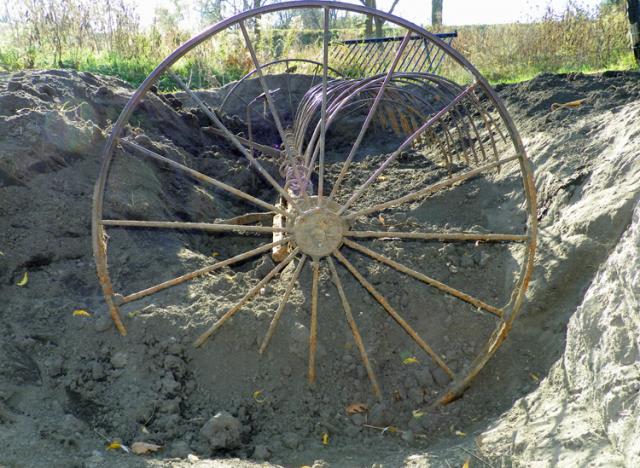 This horse-drawn hay rake may soon become a landscaping accessory in rural Brandon.
For the past five years or so, I've been the patriarch of the Close family, and the main guy to decide what to do with my grandfather's old place. I would have been quite happy to allow my predecessors to maintain that role for the next few decades, but now the job is mine.
I devoted most of 2009 to the house where my grandfather lived for decades, and where my father was born. I learned more than I thought I could about roofing, siding, porch building and flying mice.
There's a bit more work to do on the house, including figuring out how to attach a modern plumbing fixture to a decades-old iron drain pipe.
This year, the time I have devoted to the place has been about the land and what's on it, or in some cases, under it.
Like farm implements.
The only time I ever remember my father and grandfather arguing (not counting while playing cards) was when they were discussing the old farm implements. My dad considered them scrap metal; my grandfather called them "antiques."
While both of them had a point -- most of the farm's antiques are in a condition not far from that of scrap metal -- I generally agreed with my grandfather. Even if something is not in a condition to use, it could make a good lawn ornament, planter, or serve some other historical or landscaping purpose.
So, with the goal of turning this nearly-buried implement into some sort of historical display, I started digging.
I had a spade, a hoe, a rake and a pitchfork. And a garden hose.
I used the digging tools where I could, digging around the spokes of the wheels and the metal of the implement.
I only did this for an hour or two each day. When I got tired from the digging, I made a slope and ran the garden hose over the area for a few hours, hoping to wash away some of the dirt. That worked, but just a little.
I first found the bottom of one of the wheels. Then I uncovered enough of the item to realize that it was some kind of rake. I kept digging under the tines until I found a seat. At that point, I more clearly remembered seeing that item decades earlier. I could also give it a name: Horse-drawn hay rake.
I Googled that term and found a few photos of other horse-drawn rakes, some nearly identical to mine (but not covered with three feet of dirt).
Inspired by this knowledge, I kept digging. There were a few times it seemed that I would never find the lowest part of the rake, and I did consider abandoning the digging in favor of waiting until the creek washed away the rest of the dirt.
But onward I dug.
Yesterday, I found the mechanism that raises and lowers the rake. I believe I have uncovered all of the device except for the right wheel. I have some more digging to do, but now the project looks more finished than not.
Soon, I hope, I can find out which company made the item, which color it may have originally been, and where it makes the best landscaping ornament.
I had similar success -- although my kids have less flattering words for that -- with an old manure spreader.
It seems quite unlikely that I can restore the rake to working order; there is too much rust and dirt. But soon, I hope, passers by can see one more small piece of history.
Comments
Submit a CommentPlease refresh the page to leave Comment.
Still seeing this message? Press Ctrl + F5 to do a "Hard Refresh".