-
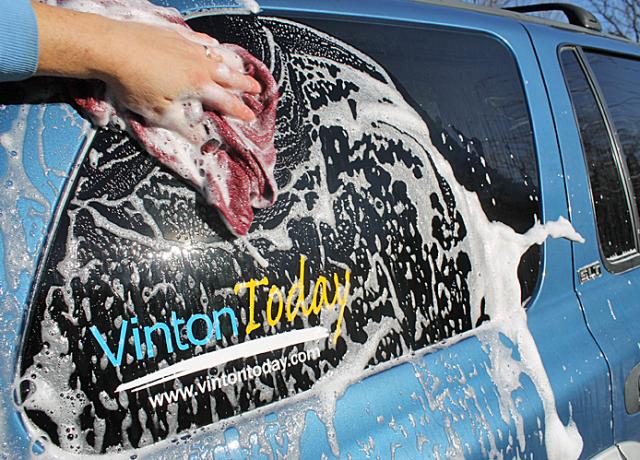 Rare opportunity: We washed our car, using the garden hose, in December.
Ah, the joys of washing your car.
The feel of suds on your hands.
The cool fresh water as it bounces off the window and tickles your face. The tiny, dazzling rainbows forming as the reflected spray refracts the sunlight. The squish of the water in your leaky shoes.
December is often a time to remember those summer joys. This year however, the unusually warm weather is offering a chance to enjoy them.
I washed the car today, for the first time (that I can remember) in December. The hose was not frozen, and with a sweatshirt, the temperature was quite comfortable.
Tomorrow, Thursday, Dec. 10, may see some near-record temperatures, with a forecast for Vinton of 56 degrees. At the time of this writing (noon on Wednesday), Jason Hicok’s Vinton Weather site indicates that the temperature is 47 degrees – the average high for the months of March and November.
If you, like me, like warm weather, and are weary of the long, cold winters we have endured the past few years, the winter that begins in a dozen days may be more to your liking.
Iowa Climatologist Harry Hillaker says that the unusually strong El Nino means that this winter is more likely to be warmer than normal and perhaps a bit drier than normal.
“Iowa has had a very mild December thus far temperature-wise,” says Hillaker, whose office is part of the Iowa Department of Agriculture.
The warm trend, he says, continues from the fall months, when September, October and the first couple weeks of November brought warmer-than-normal temperatures.
“Overall, it’s been quite mild so far,” says Hillaker, who explains that a strong El Nino pattern “very often does bring us milder than normal mid-winter weather.”
The current weather trend will reach its peak on Thursday, before cooler temperatures arrive – although the warmer-than-normal trend will continue.
Hillaker said most cities in this part of Iowa have record highs of around 60 degrees.
Yet, do not put away your shovels, gloves and insulated coveralls.
“Even with El Nino, winter weather can still get very typical,” with snow and cold weather, says Hillaker. However, those cold and snow events are typically not as frequent or as long lasting.
Wet conditions continue
Like in the early spring, soil conditions are moist; most parts of the state have above-normal soil moisture, says Hillaker.
“Even the driest areas – the northeast from Decorah to Lansing – and the southeast corner, have normal soil moisture,” he adds.
Iowa farmers had the good fortune to have a dry March, which allowed for a normal planting season despite early moisture issues. Most farmers are hoping for a dry spring.
As far as climate change, Hillaker said there has not been any noticeable trend toward warmer weather in Iowa.
“We are not seeing much of a trend. We have had some really cold winters, especially two years ago.
Most El Nino systems last about 12 months, and this one is expected soon begin to slowly weaken, says Hillaker.
In his 27 years as the State Climatologist, Hillaker has answered countless questions from residents and media.
Some of them have been amusing – at least from an Iowa perspective.
“A few years ago, during another very mild winter, a reporter from new York called. He was writing an ag story – something he did not do often. He called in January to ask how the Iowa crops were doing in the unusually warm weather.”
KCRG weatherman Kaj O'Mara shares his insights
We also asked Kaj O'Mara, a member of the KCRG-TV weather team, for his insights. In addition to his TV duties, he has spoken to area groups about weather and the life of a meteorologist.
Here are his answers to a few of our questions:
How long will this trend last ?
To me, we will likely see this go through at least Sunday which would be quite a run. That’d be five days of 50 or better consecutively. Not to say it couldn’t return again later, but for what has been a warm start to December, we’ll likely see it come to an end around Sunday night.
How connected it is to El Nino ?
I feel strongly that it’s highly connected. Looking back at previous El Nino years, this same type of behavior occurred in December of 1997, 1982, 1965, and 1957. El Nino is largely cyclical and given how strong this one is, I think it’s going to behave similarly. Of interest, we can occasionally get paid back with snow later in the season with some decent snows in March. That’s what has occurred with past El Nino events at least. Not all are created equal though.
Is this warming trend something we can expect more of this over the years because of climate change ?
No, I don’t believe we can say that. We must remember that we have gone through some of the coldest Winters over the last two years. The winter of 2013-14 was truly brutal, and rivaled record values from the brutal winters of the 70s. Winter temperature trends are also highly influenced by snowpack, which can be variable from year to year. In the 1933-34 Winter, we only had around 8” of snow. That also occurred in the 2001-02 Winter, so no definitive trends can be established or assumed at this time in regards to precipitation or temperature.
Twitter followers can find Kaj HERE.
See the Iowa Climatology Bureau Page HERE.

Comments
Submit a CommentPlease refresh the page to leave Comment.
Still seeing this message? Press Ctrl + F5 to do a "Hard Refresh".