-
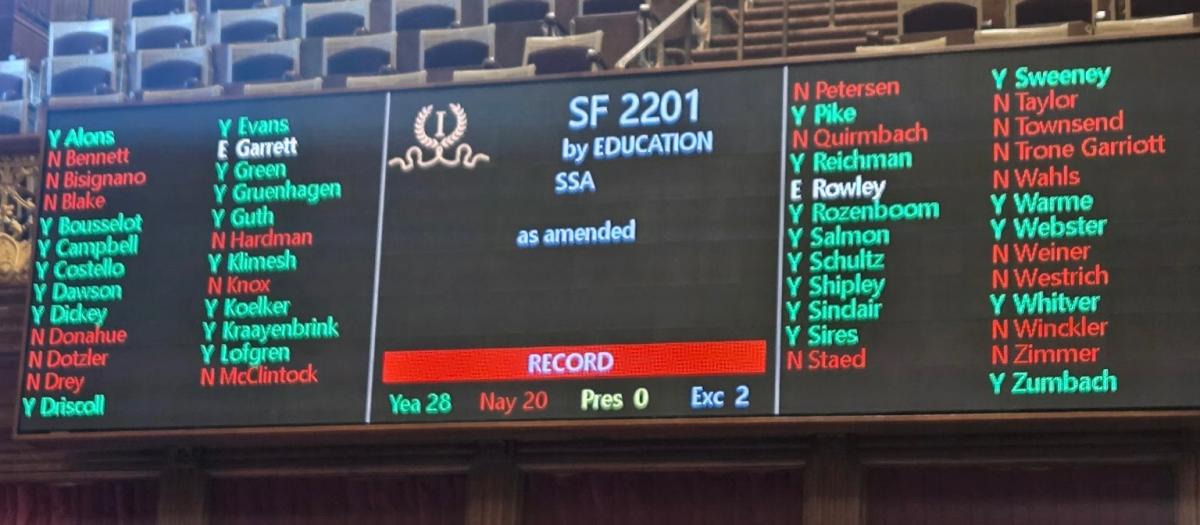 Final vote on SF 2201
 -
-
-
On Monday we began the fifth week of the legislative session. One of my main goals for the week was to get as many eligible bills through Technology as possible before the first funnel. On Wednesday, we passed three bills out of Tech, including SSB 3086, SSB 3012, and HF 864. These bills are now (first) funnel proof and will move to the Senate calendar for debate and approval.
With a full slate of committee work behind us, we held our first floor debate of the session on Tuesday. The first measure considered was SF 2096, which increases flexibility in foster parent training requirements and strengthens competency-based instruction. The bill streamlines the application process by removing redundancies while preserving thorough screening and background checks. This update helps modernize Iowa's foster care system and expands opportunities for more individuals to become foster parents. SF 2096 passed the Senate by a vote of 37-9.
The second bill debated was Senate File 2201, the Senate Republican proposal outlining K-12 education funding for the upcoming fiscal year. The plan increases funding by nearly $100 million for the next school year, bringing total state spending on K-12 education to $4.35 billion. Under the proposal, the state would provide $8,133 per student, not including federal or local contributions. When all funding sources are combined-state, federal, and local-total investment exceeds $19,200 per student. This proposal reflects a strong commitment to education, responsible budgeting, and the priorities of Iowans. It also continues Senate Republicans' efforts to ease the tax burden by increasing the state's share of property tax funding for public schools.
As we approach the first major legislative deadline next week, new proposals continue to come forward each day. If you have questions or concerns, I encourage you to reach out by email or by leaving a message with the Senate switchboard. I value hearing from constituents and welcome respectful conversations about the legislation before us, whether we agree or disagree.
Progress on Water Quality
Water quality remains a frequent and important topic of discussion at the Capitol and across Iowa. It is an issue we take seriously, as do farmers throughout the state. The Iowa Nutrient Reduction Strategy was developed to decrease nutrient runoff into surface waters, focusing on voluntary, data-driven approaches that effectively improve water quality. Since its launch, hundreds of millions of dollars have been invested in implementing practices that strengthen soil health and protect water resources.
In 2018, the legislature established a water quality infrastructure fund, created a water quality financing program, and expanded cost-share opportunities for infrastructure projects on agricultural and urban land. Senate Republicans, working with the House and the governor, advanced this long-term funding framework to support water quality efforts and collaborate with farmers on practical solutions.
While Iowa leads the nation in corn, pork, egg, and biofuel production, the state also ranks first in adopting several proven conservation practices. These include saturated buffers, buffer strips, conservation tillage, and water quality wetlands. The Iowa Department of Agriculture and Land Stewardship partners with nearly 450 public and private organizations statewide, and 2025 brought record demand for the cover crop cost-share program.
Iowa's farmers work tirelessly to feed the world while caring for the land and water that sustain their communities. They live here, raise their families here, and rely on the same water resources as every other Iowan. Moving forward, we should continue emphasizing collaboration and voluntary, research-based conservation practices rather than additional mandates or expanded government land ownership, ensuring responsible and effective improvements to water quality.
Thank You District 42!
Comments
Submit a CommentPlease refresh the page to leave Comment.
Still seeing this message? Press Ctrl + F5 to do a "Hard Refresh".