Week four brought more subcommittees and committees as we approach funnel week.
Monday brought the Iowa caucuses, which has historically been considered one of the most critical components in the election process. This meant many of us stayed home in our districts Monday so we could participate. Since 1972, Iowa has been the first in the nation to hold the caucus. Caucuses are a great time to get involved at the local level, talk with candidates and have a voice in grassroots politics. It was nice talking with constituents and party activists about important issues, grassroots activism, and what we need to focus on going into the next election cycle.
On Tuesday, I headed to Des Moines for a subcommittee on Senate Study Bill 3086. This bill removes the enforcement and civil penalty provisions that were added last year under SF 449, which had allowed the Attorney General to directly enforce the law by seeking court orders and civil penalties. Instead, the bill shifts enforcement of Iowa Code section 533C.1004 into the state ¢â‚¬â„¢s consumer fraud law by making any violation of that section an unlawful practice under section 714.16. This means violations would now be handled as consumer fraud cases. The bill also allows the Attorney General to seek higher penalties when someone violates a court injunction related to digital financial asset transaction kiosk regulations ¢â‚¬â€�up to $100,000, even though the normal cap under the consumer fraud law is $40,000. Finally, the bill removes the current rule that treats a single course of conduct affecting multiple people as just one violation. Under the bill, if the same conduct harms multiple people, each affected person could count as a separate violation, which could significantly increase the total penalties that may be imposed.
On Wednesday, we held our third meeting of the Senate Technology Committee. Senate Study Bill 3010 and 3013 were brought forward and passed. SSB 3010 prohibits any person from engaging in atmospheric pollution, cloud seeding, or other weather-engineering activities, and from using unmarked or unidentified aircraft, vehicles, or facilities to conduct such activities. SSB 3013 clarifies ownership of content generated using artificial intelligence.
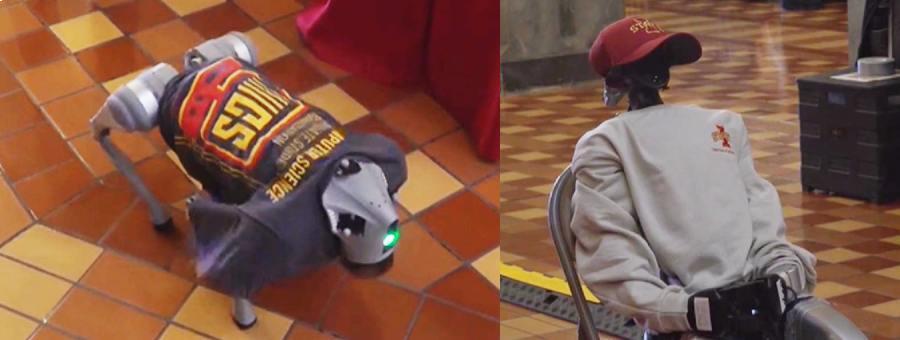
Not only was Wednesday a busy day in committees and meeting with constituents, but the Capitol also hosted Iowa State University. As always, it was a pleasure meeting with some of the faculty and students. Some of the students shared recent projects they have worked on and current research. I am excited to hear what other students and universities are doing this school year as they meet with us at the Capitol this session.
More on Property Taxes
Property tax relief continues to be an important conversation at the Capitol. As I work through these proposals, I ¢â‚¬â„¢m hearing a lot of feedback from Iowans, local governments, and other stakeholders about the best path forward. I ¢â‚¬â„¢m supporting what would be the largest property tax overhaul in decades, with a focus on helping Iowans achieve the American dream right here at home, making homeownership more affordable, and ensuring our property tax system works for everyday people.
Under this proposal, once you ¢â‚¬â„¢ve finished paying off your home and you ¢â‚¬â„¢re at least 60 years old, you would no longer be required to pay involuntary property taxes ¢â‚¬â€�you would truly own your home. The plan also includes a permanent 50 percent taxable value discount for most homeowners and automatically reduces property tax levies when property inflation exceeds 2 percent.
Right now, Iowa ranks as the tenth worst state in the nation for property taxes. I ¢â‚¬â„¢m working to improve that ranking with a proposal that modernizes the system, recognizes the differences between rural and suburban Iowa, and delivers real relief. This plan is centered on helping homestead Iowans, and I look forward to continuing the conversation as the legislative session moves forward.
Another major focus each year is K—12 education funding. Since 2017, Republicans have appropriated more than $1.23 billion in new funding for Iowa schools. This year, the Senate is proposing an increase of nearly $100 million for the upcoming school year, bringing total state spending on K—12 education to $4.35 billion.
Next week, we will likely see a floor voted on SSA, Supplemental State Aid. SSA is a critical component in student success by providing districts with adequate general fund resources.
I will be reluctant to vote for the proposed amount. However, will depend on the total package presented.
Our children's education is our state's future.
| 
Comments
Submit a CommentPlease refresh the page to leave Comment.
Still seeing this message? Press Ctrl + F5 to do a "Hard Refresh".