Home gardeners and commercial broccoli growers preparing for spring planting are encouraged to review practical insights from a new Iowa State University Extension and Outreach resource. “Broccoli Production in the Midwest” is available for download at no cost from the ISU Extension Store.
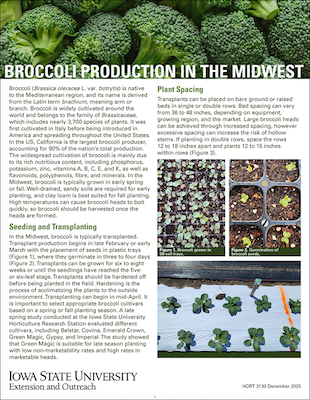
The publication covers the production cycle from seed transplanting to harvest, including specific fertilizer recommendations based on soil tests, irrigation requirements, optimal spacing for quality head development and weed, pest and disease management best practices. Findings are shared from studies conducted by horticulture researchers at the ISU Horticulture Research Station in Ames, Iowa.
Graduate research assistant in the Department of Horticulture and publication co-author Akshaya Thinakaran noted that selecting the appropriate cultivar based on spring or fall planting is a critical decision.
The research also identified an effective non-chemical approach to managing insect pests in broccoli production. ExcludeNet mesotunnel netting reduced pest damage more than any other method tested.
“Mesotunnels are covered with a nylon mesh fabric that is placed over electrical conduit hoops, and have a height of 3.5 feet,” noted Ajay Nair, professor and chair in the Department of Horticulture at ISU, extension vegetable specialist and publication co-author. “These nylon nets are breathable, durable, light-permissible and protect plants from extreme weather conditions like heat and hail.”
According to the publication, broccoli is rich in nutrients, providing vitamins A, B, C, E and K, along with minerals such as phosphorus, potassium and zinc. Broccoli also contains beneficial compounds such as flavonoids, polyphenols and fiber. Iowa growers can reliably grow broccoli as a nutritionally valuable crop for diversifying operations and meeting consumer demand for local vegetables.
For more information, access the publication or contact Nair at nairajay@iastate.edu or Thinakaran at akshayat@iastate.edu.
This work is supported by the USDA National Institute of Food and Agriculture Organic Agriculture Research and Extension Initiative grant no. 2023-51300-40855.
Comments
Submit a CommentPlease refresh the page to leave Comment.
Still seeing this message? Press Ctrl + F5 to do a "Hard Refresh".