By Faith Hunt, Naturalist
It's that time of the year when daylight is shorter and the temperature can be bitterly cold. Finding the motivation to explore outside may become a little harder, but wildlife tracking can be a fun way to engage with the world around you during these colder days. Snowy conditions are some of my favorite times to explore. I love how the snow muffles sound, amplifying the calls of birds close by, the rattle of branches in the wind and the subtle rustle of critters scrounging for their next meal. Snow acts as a canvas, painting a story through wildlife tracking.
The earliest direct evidence of wildlife tracking was found about 70,000 years ago (although believed to be much older) and has been described as the “first science” because it represents the origin of scientific thinking, requiring early humans to use observation, hypothesis and deductive reasoning in order to survive. Luckily, we don’t have to be expert trackers to survive, but we can use tracking as a way to explore nature.
Wildlife tracking includes usage of pattern recognition, gathering and processing information, and some imagination for interpretation. When you stumble upon wildlife tracks, ask yourself these fundamental questions: Who made these? What was the animal doing? When were these tracks made? Why was the animal here? Where was the animal coming from and where was it going to?
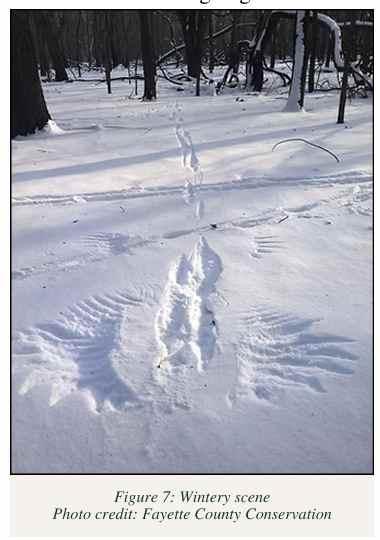
If you look closely, coming from the trees are a set of tracks, it appears to be an animal that hops (likely a rabbit). In the center of the photo, dashes seem to appear out of nowhere. The splayed dashes are wings lightly hitting the snow, the further you get from the trees, the more defined the swoosh marks get, until you see where the animal landed in the foreground. The landing area is also where the hopping animals' tracks stop. What do you think happened in this woodland scene? Wildlife tracking is more than their actual tracks, but also looking for signs that animals have been in an area. This can also help explain the animals behavior and help identify the animal who made these clues. Look for evidence such as rubs, scat, beds, nests, and evidence of feeding or predation. When you are lucky enough to combine wildlife signs and tracks, things really start to get fun!
The beauty of wildlife tracking is that it creates curiosity for all ages and can help us connect with nature. Tracking allows us to find wonder and change perspectives in a familiar place with new appreciation. It helps us slow down and look a little closer. No matter if it’s in your yard or the woods, finding animal tracks in the snow is a great way to beat cabin fever and explore the outdoors. Make sure you get outside and see what new things you can discover!
"The real voyage of discovery consists not in seeking new landscapes but in having new eyes," -Marcel Proust
Comments
Submit a CommentPlease refresh the page to leave Comment.
Still seeing this message? Press Ctrl + F5 to do a "Hard Refresh".