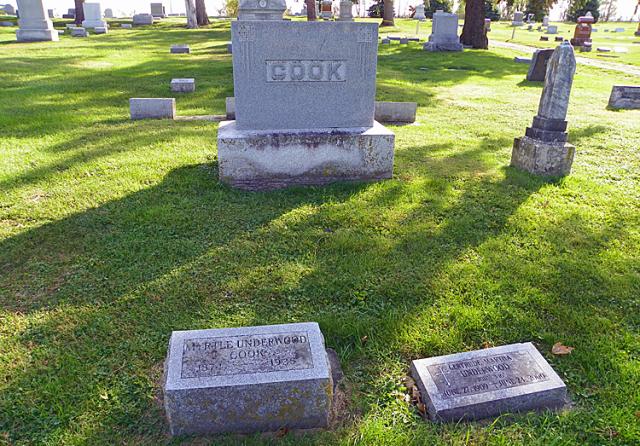
 White robes & a burning cross were part of Myrtle Cook's funeral after the KKK/WCTU member's murder.
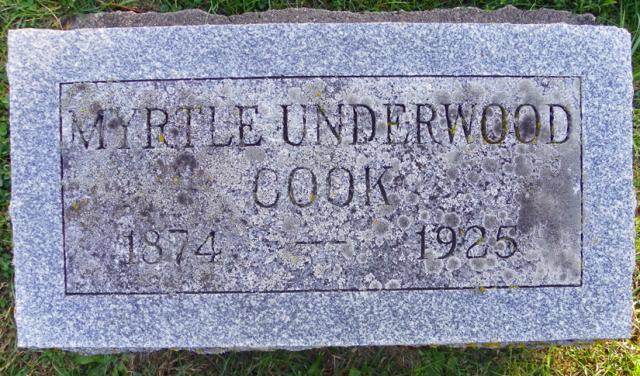 Myrtle Underwood was laid to rest at Evergreen Cemetery after her murder in September of 1925.
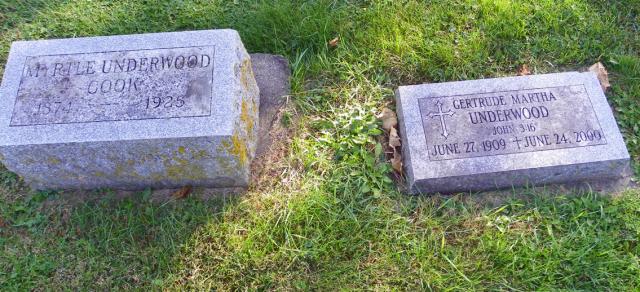 Gertrude was 16 when her mom was killed; she died in 2000.
 Myrtle Cook was shot to death in 1925 through a window in this house; nobody was charged.
Myrtle Cook's last words probably got her killed.
Cook was sitting near the window of her home at 703 Third Avenue, across the street from the busy Vinton train depot, rewriting and rehearsing outloud her speech to an upcoming Women's Christian Temperance Union (WCTU) meeting.
But as President of the Benton County WCTU, Cook did more than give speeches. She had recently published the names of people she suspected of bootlegging. These claims could -- and did -- lead to legal problems and jail time for those on her lists. She was bad for business, too.
Also, she was, when it came to the subject of Prohibition, not at all a diplomat. One newspaper, after her death, said she caused some people to "emphatically detest her."
Her house had been egged the previous July 4; she believed the youths who threw the eggs had been hired by bootleggers to intimidate her.
She worried a bit, telling a friend that "this work may be the end of me yet."
Cook's mother-in-law was upstairs that night, listening to her recite her speech over the noise of a thunderstorm and a rumbling from the railroad tracks.
The mother-in-law heard what she thought was thunder. And then silence. She headed downstairs, where she saw Cook on the floor, gasping and bleeding from her chest. A bullet had entered the house through the window and entered Cook's heart. She was dead within an hour.
This took place 86 years ago, on the night of Sept. 7, 1925.
Historical cold case
Of the more than 500 cold cases of unsolved murders, disappearances and unidentified corpses found in Iowa, Vinton's only cold case is among Iowa's most studied. Cook was a member of the WTCU -- and more significantly -- the KKK. The preacher who officiated the funeral dressed in the iconic white robe of Ku Klux Klan. Several other Klan members lined the sidewalk as Cook's casket made its way from the church to Evergreen Cemetery. A cross was set on fire at the graveside ceremony. While Mrs. Cook was a member of the Christian Church, the funeral was held in the Methodist Church because it was larger. The pastors who officiated the service were both members of the KKK, wrote Tobin. The sermon title was "Did she die in vain?"
The murder of a woman who had been fighting bootleggers and whose funeral was attended by a very visible Klan contingent made news all over the United States. Cook's story is still considered a noteworthy part of that era of history and has been mentioned in many books and college courses.
The identity of her killer remains a mystery, although Vinton's most famous judge, John W. Tobin, wrote in 1986 that he believes he knows who pulled the trigger. Others, however, pointed the finger at Cook's estranged husband, Clifford, who was living in Sioux City at the time of the murder, and who had begun a relationship with another woman before his wife's murder.
The presence of the KKK, and the history of the Prohibition movement are the main sources of historical interest in the case.
In his 1986 book, "Tobin Tales," Tobin, who became a District Judge in 1954, devoted an entire chapter to the KKK, Prohibition and Myrtle Cook.
Cook's last words
Tobin had returned from World War I and was in partnership with his father and brother in the Tobin, Tobin and Tobin firm when the murder took place. Cook's written speech found at her table after her death included the following words:
"To say America cannot enforce Prohibition is to do violence to America's tradition and to underestimate the American spirit. American will-power has turned apparent impossibilities into wondrous achievements…we need women how are unafraid, just as our mothers, women who believe in God, and home, and country. Women who stand for purity and truth -- a strong, united sisterhood will reinstate the old-fashioned religion in our schools and over the land.. Friends are we afraid to take up the burden? But it is hard for someone to keep on the firing line all the time. Others must put their shoulders to the wheel. Let us pray that every Christian woman will enlist…"
Cook, said Tobin, was not popular. Her messages in support of Prohibition offended those who wanted to buy or sell alcohol, as well as those who did not drink but did not support the prosecution of those who did.
Local news vs. national sensationalism
Tobin quoted a Cedar Valley Daily Times editorial that summarized Cook's approach toward people, and their response toward her:
"She was not diplomatic in her work for Prohibition. It was not in her nature to be diplomatic. She was not generally liked. Many people most emphatically detested her. That was because she was generally regarded as being meddlesome."
Still, said the Times editor, "People are not murdered because they are disliked."
The editorial went on to mention how the murder had changed the views of Vinton residents: "Men and women who formerly were indifferent have been sharply awakened to the menace of the booze ring."
Tobin said that the two Vinton newspapers, the Times and Eagle, "gave the community accurate and detailed reports of the developments."
But, he adds: "Not so the outsiders."
The murder, as well as the KKK presence at the funeral, "combined to capture the attention of newsmongers nationwide," wrote Tobin.
Dozens of reporters flocked to Vinton, quoting everyone who would talk to them. The result, said Tobin, was that "they falsely depicted the town as a friendly harbor for criminals and a welcoming rendezvous for bootleggers and all other evil-doers."
Whodunit?
Cook's estranged husband, Clifford, emerged as a suspect, although he claimed he had been stranded by a rain storm in Grundy Center that made the roads too muddy for driving. He also gave the authorities conflicting or false information about his relationship with a woman named Hester Seiling, whom he later married. But, wrote Judge Tobin, a salesman who had been in Grundy Center told authorities that he had seen Clifford Cook at the hotel on the night of the murder, verifying Cook's story. Tobin came to the conclusion that Clifford Cook had been unfairly accused of his wife's murder.
A more likely suspect, wrote the judge, was a young man named Harold Ponder. Tobin said that Ponder's acquaintances described him as a "lamebrain," "dingbat" and "blabbermouth." Ponder had been in trouble with the law on many occasions, and escaped from a state penitentiary the week before the murder (after being arrested for stealing a car). Ponder disappeared after authorities began considering him a possible suspect, and was never heard from again, wrote Tobin.
"In due time it came to be believed that after doing this job, he had been disposed of by the persons who hired him, to avoid any possibility that they might be implicated by the "blabbermouth."
(Ironically, former Benton County Sheriff Kenneth Popenhagen, who was in office when four unsolved murders took place between 1977 and 1981, said the same thing happened to the prime suspects in those cases: They died before the could face prosecution.)
Still, according the judge, nobody knew for sure if Mrs. Cook was killed by someone who opposed her association with the KKK, or someone who opposed her stance on Prohibition.
Lasting impact
The incident -- and coverage by the national media -- gave Vinton an unfairly bad name, wrote Tobin.
"Long-lasting damage was done to the reputation of a town that for 70 years has been looked upon as a good town, one of the better county-seat towns in the state," according to the judge.
Yet, he concluded, her murder had some positive effects on the community. The images of the white robes and burning cross turned off Vinton residents to the KKK. Soon, the Klan leaders were informed that their secret meetings were not acceptable.
"The Klan took heed," wrote Tobin. "It went underground. For a while it lingered on, and then died out completely in Vinton."
Also, he wrote, people on both sides of the Prohibition issue became more forceful in opposing lawbreakers: "Drinkers and non-drinkers alike came to a recognition that the bootleggers and rum runners were a bad and dangerous gang and that the town was better without them."
Vinton, he said, became more law-abiding.
"The slaying of Myrtle Cook was the catalyst for decency and law obedience that made it a better town. The minister's funeral question can be answered -- emphatically: She did not die in vain," concluded Tobin.
Lasting mystery
The Iowa Cold Cases web site concludes its story about Cook with the question, "Who murdered Myrtle Cook?" still unanswered.
Researcher Nancy Bowers writes:
"Myrtle Cook is often mentioned in scholarly works about the W.C.T.U. and is invariably proclaimed to have been assassinated because of her prohibition work. Most, however, overlook her Klan affiliation. Newspapers of her time began a debate which could still be held today. The September 25, 1925edition of the Sioux County Index stated: “The public would like to know whether it was a bootleg murder or an anti-Ku Klux murder, and that seems still uncertain.” There is a third possibility as well. Myrtle may have been killed by a husband who shared little of his wife’s life, felt constrained by her rigid views, and wished to be free to marry someone else. The mystery and the questions endure."
Click to view the excerpt from Judge Tobin's book "Tobin Tales" click here.
Comments
Submit a CommentPlease refresh the page to leave Comment.
Still seeing this message? Press Ctrl + F5 to do a "Hard Refresh".
Jane - Am sure you are thinking of George Carlson who is the poet. Know there is a book but don\'t have a copy.
(Editor\'s Note: I saw the photo; but it was not good enough quality to scan. I am trying to find out about any family connections, but I have no information yet! -DC)